
How to Sign Your Delaware Car Title
Published on 8/13/2026
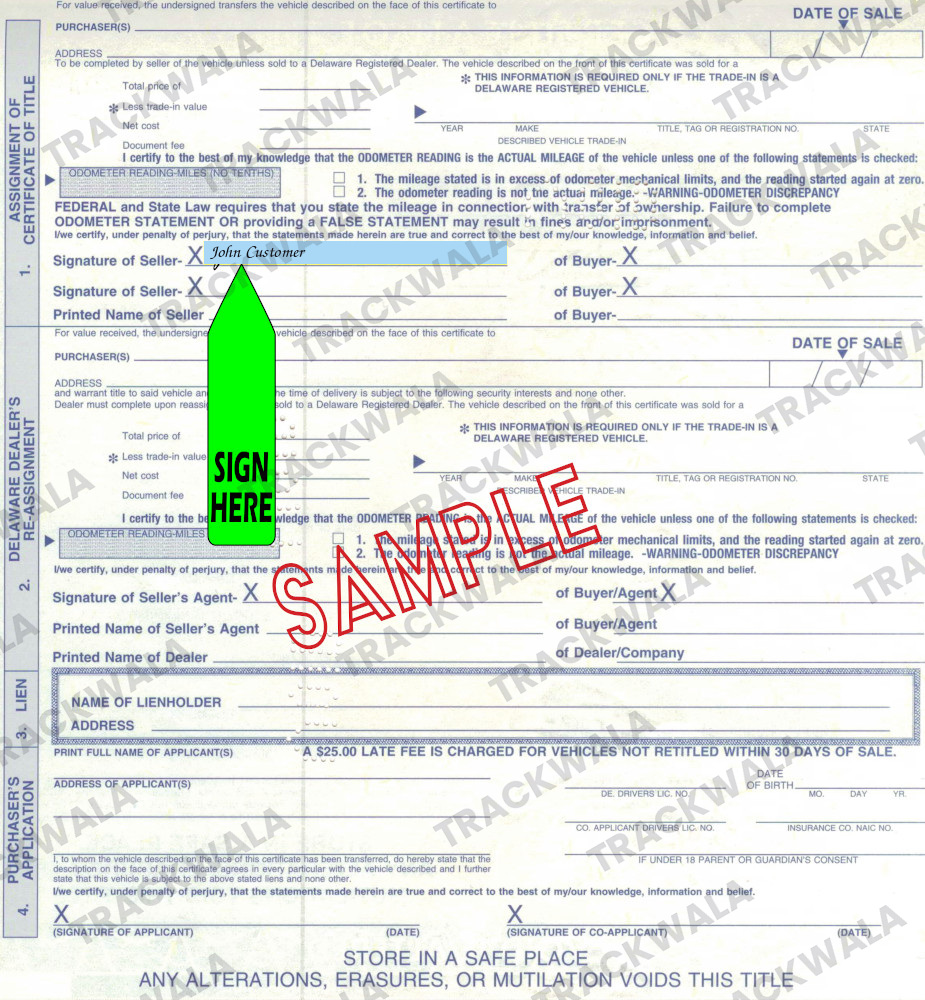
Delaware runs its assignment down the left margin of the certificate, numbered one through four. Section one is yours. Everything below it belongs to dealers, lienholders and the buyer.
Sign in the right place and you're done in under a minute. Sign in the wrong one and you're applying for a duplicate. This guide keeps you in the first group.
The highlighted bar is where your signature goes. The arrow points to it. Nothing else on the page needs your handwriting unless the form asks for it by name.
Where to sign on your Delaware title
Section 1, headed Assignment of Certificate of Title, near the top of the page. The highlighted bar covers the first Signature of Seller line, which begins with an X and sits left of the buyer's line.
Three rules that keep a title valid
- Match the printed name exactly. Whatever the face of the title says is the version that goes on the signature line. Nicknames, dropped middle initials and married-versus-maiden mismatches are all reasons a transfer gets bounced back.
- Stay inside the highlighted box. Every other line on the page belongs to the buyer, a dealer, a lienholder or a notary. Adding your handwriting to any of them is an alteration, and alterations void assignments.
- When you're unsure, stop. An unfinished title can be finished. A wrongly marked one usually can't. Reach us on {{TRACKWALA_PHONE}} before you commit ink to paper.
Delaware charges you for being slow
Printed in the purchaser's application section is a plain warning: a late fee applies to vehicles not retitled within thirty days of sale. That clock starts at the date of sale, not the date the buyer gets around to visiting the DMV. Fill in the date of sale accurately and get the signed title moving — a vague or backdated date creates problems for the buyer that eventually come back to you.
What voids a Delaware title
The Delaware Division of Motor Vehicles rejects titles for the same handful of reasons, year in and year out:
- Correction fluid or tape. There is no version of this that a DMV accepts.
- Crossing out and rewriting. Even a neat single strike-through is an alteration.
- Signing in a dealer reassignment block. Those rows are reserved for licensed dealers.
- Signing the buyer's line. It reads as though the buyer signed, which is a forgery question nobody wants.
- Pencil, or unusual ink colours. Blue or black ballpoint, every time.
None of these are recoverable with a pen. Every one of them means a duplicate title application.
Before you send your title to TRACKWALA
Run through this list before the document goes in an envelope:
- The name you signed matches the name printed on the face of the title.
- The odometer reading is written in whole miles, no tenths.
- The date is the actual date of sale.
- Nothing outside the highlighted area has been marked.
- You've photographed both sides of the completed title for your own records.
That last point is the one people skip and later wish they hadn't. A photo of the completed assignment is the only proof you have of what you handed over and when.
Delaware title questions we get asked
There are two Signature of Seller lines in section 1. Do I use both?
Only if the title lists two owners. One owner, one signature on the first line.
What if my name has changed since the title was issued?
Sign the name as printed on the title, then be ready to show documentation of the change. Some states want a supporting document attached; we'll tell you which applies to yours.
Do I need to write the odometer reading in tenths?
No. Every state on this list asks for whole miles with no tenths, and most print (no tenths) directly on the form. Round down to the whole mile.
Get your Delaware title moving
TRACKWALA handles vehicle title work every day, in every state, and we've seen every version of a signature gone wrong. If you're looking at your Delaware certificate and you're not completely sure where the pen goes, send us a photo before you sign. It costs nothing and it saves weeks.